Body mass index, or BMI, often gives clinicians the first measurement they use when assessing someone for weight management treatment. It compares weight with height and offers a simple starting point for discussion. On its own, BMI does not show the full picture of health. Even so, it helps healthcare professionals decide whether further assessment may be useful. NICE’s guidance on weight management and obesity in adults explains that clinicians commonly use BMI as part of a wider clinical assessment — not as a standalone decision tool.
A single number never decides everything. Clinicians also review medical history, weight-related health conditions, current medicines, lifestyle, pregnancy status, and whether treatment is safe and suitable for the individual. NHS guidance on obesity treatment makes clear that treatment decisions usually involve more than one measure and often include lifestyle support, realistic goals, and follow-up care.
In the UK, prescription weight management medicines serve specific clinical purposes — not casual or cosmetic ones. A prescriber should only consider them after a proper clinical review. The MHRA guidance on GLP-1 medicines for weight loss and diabetes confirms that regulators license these medicines for specific medical disorders, and clinicians should not use them simply for aesthetic weight loss.
If you want confidential support from a regulated provider, our online weight management consultation service explains how assessment and follow-up work in practice.
Why Clinicians Use BMI
BMI helps clinicians place adults into broad weight categories and identify people who may benefit from further review. Healthcare teams use it widely because it is simple, quick, and standardised. In many services, BMI acts as the first checkpoint before a clinician decides whether treatment might be appropriate. NICE includes BMI in its classification of adults living with higher weight and obesity, while also making clear that assessment should not stop there.
Still, BMI has clear limits. Direct measurement of body fat falls outside what this single number can capture. Muscle mass goes undetected, and the location of fat across the body remains invisible. Those limits matter because two people with the same BMI may face very different health risks. For that reason, healthcare professionals do not rely on BMI alone. They may also look at waist measurement, metabolic risk, cardiovascular risk, and diabetes risk. NICE supports a fuller assessment rather than using BMI in isolation.
This point matters even more in pharmacy-led care. A pharmacist prescriber or clinician must justify that treatment suits the individual patient. That means checking whether the person meets broad criteria, whether their health history supports treatment, and whether any contraindications exist. The decision must remain lawful, safe, and grounded in the person’s actual clinical needs — in line with the Human Medicines Regulations 2012 and GPhC standards for responsible prescribing.
General BMI Thresholds for Weight Loss Treatment
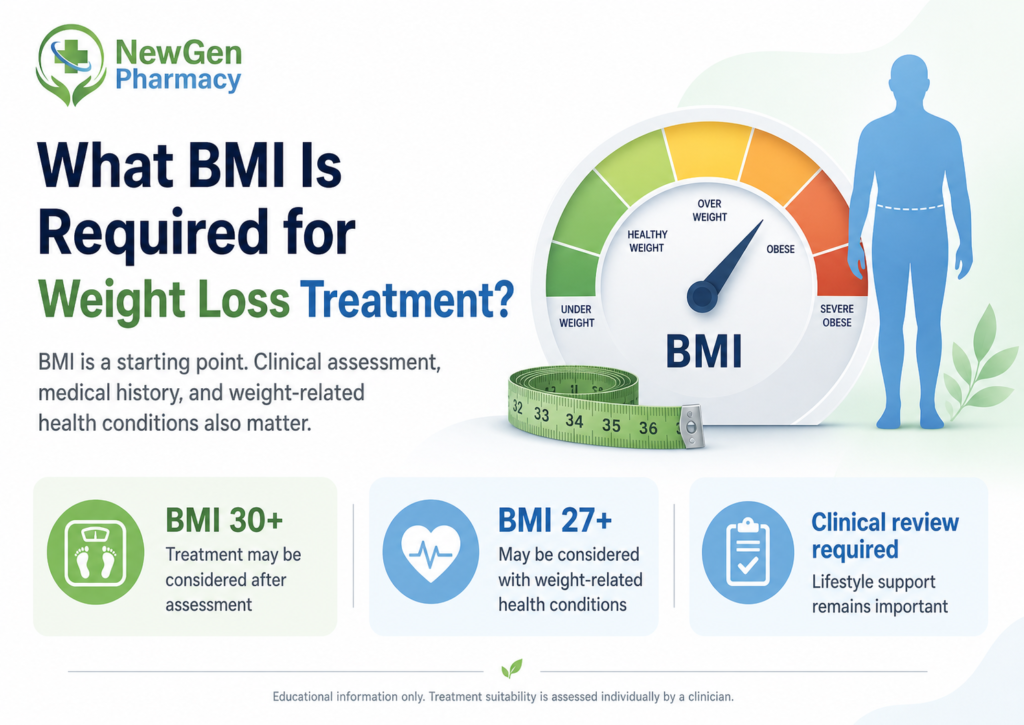
In broad terms, clinicians may consider weight management medicines for adults who:
- have a BMI of 30 or above
- have a BMI of 27 or above alongside at least one weight-related health condition
These general thresholds reflect the licence-based starting points for some weight management medicines, including semaglutide and tirzepatide. NICE’s appraisals of medicine options for weight management in adults make clear that clinicians must read medicine choice alongside relevant NICE technology appraisals and NHS commissioning guidance.
Weight-related health conditions may include high blood pressure, type 2 diabetes, sleep apnoea, or cardiovascular risk factors. In practice, a clinician will look at whether body weight contributes to health risk and whether treatment is likely to help. NHS obesity treatment guidance explains that treatment may involve lifestyle change, medicines, or surgery depending on BMI and related health conditions.
Many people misunderstand this stage. Reaching a certain BMI does not mean treatment will automatically follow. A qualifying BMI may make someone eligible for further assessment, but a prescriber still needs to decide whether treatment is suitable, safe, and lawful for that person.
NHS Criteria and Private Prescribing Are Not the Same
One of the most important points to understand is that NHS access and private prescribing follow different rules.
On the NHS, access is often narrower than the general medicine licence allows. NICE and NHS England set formal criteria for which patients can receive certain treatments within NHS pathways. NHS England is currently rolling out tirzepatide in phases, and healthcare professionals must discuss the benefits, limitations, and side effects before prescribing it.
Private prescribing still carries strict legal obligations. It does not offer a shortcut around safe prescribing standards. Under the Human Medicines Regulations 2012 and GPhC guidance, a prescriber must take a full history, assess current health, review existing medicines, check pregnancy and contraception issues where relevant, and confirm the treatment fits the patient’s clinical needs. The MHRA stresses that safe use of GLP-1 medicines depends on proper medical supervision and the right clinical indication.
Because of that, a compliant pharmacy website should avoid language that sounds automatic or guaranteed. A safe and lawful UK pharmacy page should present treatment as something a clinician considers after thorough assessment — not something a person simply qualifies for based on BMI alone. This reflects the requirements set out by the GPhC, MHRA, and ASA for responsible promotion and prescribing.
What Else Do Clinicians Consider Besides BMI?
BMI is only one part of the decision. Before any treatment discussion, clinicians also assess:
- current and past medical history
- weight-related health conditions, including diabetes and cardiovascular disease
- current medicines and possible interactions
- pregnancy, breastfeeding, and contraception where relevant
- eating habits, activity levels, and daily routines
- previous weight-management efforts and outcomes
- side-effect risk, mental health factors, and general suitability
This broader approach reflects NICE Clinical Guideline CG189 and standard UK prescribing practice. The aim is not simply to check whether someone crosses a BMI line. Instead, the goal is to decide whether treatment is likely to help, whether the clinician can use it safely, and whether the person will receive proper support during treatment.
For that reason, two people with the same BMI may leave a consultation with different outcomes. One may have a clear clinical need and no major safety concerns. Another may benefit from more review first, or may suit a different treatment pathway better. You can read more about how this works on our weight management treatment page, which outlines how assessment, monitoring, and clinical support fit together.
Why Lifestyle Still Matters
Even where BMI and health history suggest treatment may be appropriate, medicines should not replace healthier habits. Successful weight management usually includes balanced eating, regular physical activity, realistic goals, and longer-term support. Weight loss medicines and other medical options should sit within that wider plan — not replace it.
This matters for both safety and long-term results. People who start treatment without building sustainable habits may struggle more with progress over time. They may also place unrealistic expectations on medicines that are designed to support — not substitute — healthy daily choices. Treatment may help some people feel less hungry or fuller for longer, but decisions around food, activity, sleep, and routine remain essential every day.
Clinicians often discuss readiness and ongoing support alongside BMI. A medicine may be clinically appropriate, but the patient still needs to understand how to use it, how to manage side effects, and how to build habits that support progress. Our GLP-1 lifestyle and nutrition support page explains how sustainable habits work alongside treatment more effectively and what practical guidance our team provides during your programme.
When to Seek Advice
You should seek professional advice if you are managing body weight, have a BMI in a clinical treatment range, or live with health conditions that may relate to body weight. It also makes sense to ask for advice before starting any medicine, particularly if you are unsure whether it is suitable or lawful in your situation.
Advice becomes even more important if you have diabetes, cardiovascular disease, high blood pressure, a history of pancreatitis, questions about pregnancy or fertility, or concerns about medicine safety. A clinician can then decide whether treatment is appropriate, whether further checks are needed, or whether another pathway suits you better. That kind of clinical review forms a core part of responsible pharmacy practice under the GPhC Standards for Pharmacy Professionals and the NHS Code of Conduct for prescribers.
How NewGen Can Help
NewGen Pharmacy offers confidential consultations where people can discuss medical weight management with experienced clinicians and pharmacist prescribers. We explain how BMI is used, what other clinical factors matter, and how lawful prescribing decisions are made in UK regulated practice.
Our pharmacist prescribers and clinicians can:
- explain how BMI fits into a full weight-management assessment
- discuss which health factors may affect clinical eligibility
- help you understand safe and lawful treatment pathways under UK law
- support sustainable lifestyle habits alongside any treatment programme
- provide ongoing monitoring and follow-up throughout your care
If you are ready to take the next step, book a confidential consultation with one of our pharmacist prescribers. You can also visit our weight management treatment page to understand the process before you decide.
Frequently Asked Questions
What BMI do you usually need for weight loss treatment in the UK?
In broad terms, clinicians may consider treatment for adults with a BMI of 30 or above, or 27 or above alongside at least one weight-related health condition such as type 2 diabetes or high blood pressure. However, BMI alone does not decide treatment — a full clinical assessment is always required.
Does meeting the BMI threshold guarantee a prescription?
No. A prescriber still needs to review your health, medical history, current medicines, and overall suitability before deciding whether treatment is appropriate and lawful. Meeting a BMI threshold opens the door to assessment, not to an automatic prescription.
Is NHS eligibility the same as private prescribing?
No. NHS access follows narrower criteria set by NICE and NHS commissioning bodies. Private prescribing still requires a full clinical assessment and must meet the same lawful standards under the Human Medicines Regulations 2012 and GPhC guidance — but the eligibility pathways can differ.
Can I get weight loss medicine for cosmetic reasons only?
No. UK law and MHRA guidance are clear that GLP-1 receptor agonists and other prescription weight management medicines should not be used for purely aesthetic or cosmetic weight loss. Regulators license them for specific clinical indications, and prescribers must document a lawful clinical reason before issuing a prescription.
What laws govern private weight management prescriptions in the UK?
Private prescriptions in the UK are governed by the Human Medicines Regulations 2012, the Medicines Act 1968 (as amended), GPhC Standards for Pharmacy Professionals, and MHRA licensing conditions. The Advertising Standards Authority (ASA) also regulates how weight management services are promoted. Together, these frameworks require that prescriptions are clinically justified, properly documented, and issued only after appropriate assessment.
What is the difference between semaglutide and tirzepatide?
Both are injectable medicines used in weight management. Semaglutide acts on one hormone receptor (GLP-1), while tirzepatide acts on two (GLP-1 and GIP). Both require a valid clinical indication and a prescription from a registered prescriber. Tirzepatide is currently being rolled out by NHS England in phases, while semaglutide has been available in both NHS and licensed private pathways for longer. A clinician will assess which option, if any, is appropriate for your individual situation.
Is it safe to use weight loss medicines long-term?
Long-term safety data continues to grow for medicines such as semaglutide and tirzepatide. Current evidence, reviewed by the MHRA and reflected in NICE appraisals, supports their use under medical supervision for eligible adults. That supervision includes regular monitoring, dose reviews, and assessment of any side effects. These medicines are not intended for short-term or unsupervised use.
Can people living with type 2 diabetes access weight management treatment?
Yes, in many cases. Type 2 diabetes is one of the weight-related health conditions that may lower the BMI threshold for treatment eligibility. Some GLP-1 medicines are also licensed for blood glucose management in type 2 diabetes, separate from their weight management indication. A clinician will assess whether the chosen medicine is appropriate for both conditions and will coordinate care accordingly.
What else matters besides BMI when clinicians assess eligibility?
Key factors include diabetes risk and history, cardiovascular health, current medicines and potential interactions, previous weight-management attempts and outcomes, pregnancy-related considerations, mental health, and whether the person can engage safely with treatment over time.
Compliance note: NewGen Pharmacy does not promote prescription-only medicines publicly in a promotional way. Treatment options are discussed privately by a clinician only after an appropriate assessment, and only where prescribing is safe, lawful, and clinically justified. This approach reflects the requirements of the MHRA, GPhC, NHS, NICE, and ASA as they apply to regulated UK pharmacy and prescribing services.
Author & Clinical Content Writer: Dr. Naeem Aslam