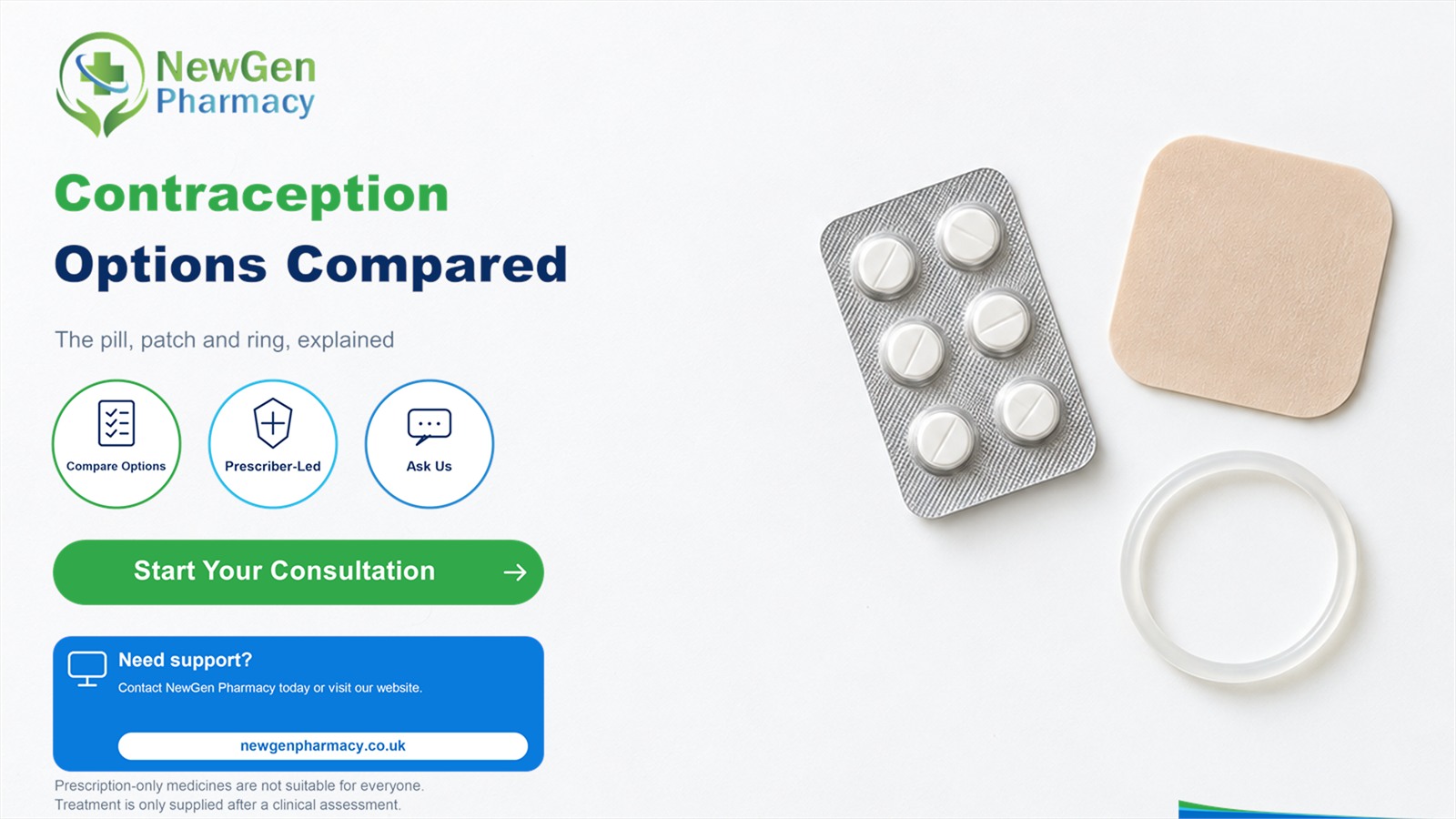
Choosing between contraception options is rarely a question of which method is best. It is a question of which method fits your health, your routine, and the thing you would be most likely to forget.
There is no single right answer, and an honest guide has to say so early. A method that suits one person perfectly may be unsuitable, or unsafe, for someone else with a different medical history.
Most importantly, the differences that matter clinically are not the ones most people compare. Patients tend to compare convenience. Prescribers compare blood pressure, migraine history, clotting risk, age, smoking status and everything else you already take.
This article sets out the main contraception options available in the UK, how effective they are in real life, who each tends to suit, which ones cannot be provided online at all, and what to do when a dose is missed. It also corrects two things patients are still told wrongly: the antibiotic myth, and the missed-pill window.
Patients ready to start an assessment can read about the combined pill, the progestogen-only pill, the patch and ring, the emergency contraceptive pill or period delay, or see how a consultation works first.
In this article
- Effectiveness: the number that actually matters
- The combined pill
- Warning signs that need urgent help
- The progestogen-only pill, or mini pill
- What to do if you miss a dose
- The patch and the vaginal ring
- The injection, the coil and the implant, and why they are not online
- Emergency contraception, and the clock
- Period delay is not contraception
- The antibiotic myth
- What no method here protects against
- Switching, stopping and reviewing your contraception options
Effectiveness: the number that actually matters
Contraceptive effectiveness is quoted two ways, and the gap between them explains most unplanned pregnancies. It is the first thing worth understanding before comparing contraception options against each other.
Used perfectly, meaning never late, never missed and never interrupted by illness, the pill, patch and ring are all over 99% effective. That is the figure most people remember.
Used the way real people use them, the NHS puts all three at 91% effective. In other words, about 9 in 100 users will become pregnant over a year. The NHS sets out how well each method works at preventing pregnancy side by side.
Because that gap comes almost entirely from human error and not from the medicine failing, the most effective method for you is usually the one you are least likely to get wrong. A method used imperfectly is less effective than a less convenient method used correctly.
This is also why long-acting methods, which remove the daily or weekly decision altogether, are the most effective of all, and why they are worth discussing with a clinician even though they cannot be supplied by post. They still belong on any honest list of contraception options, even the ones NewGen cannot supply directly.
The combined pill
The combined pill is one of the most familiar contraception options and contains two hormones, an oestrogen and a progestogen. It works mainly by preventing ovulation, and also by thickening cervical mucus so sperm cannot pass easily.
It is taken daily. Many people also find it makes periods lighter, more predictable and less painful, which is a genuine reason some patients choose it beyond contraception itself.
The combined pill has the longest list of reasons it might not be suitable, which is one reason it sits alongside other contraception options rather than replacing them for everyone. Because it contains oestrogen, a prescriber has to rule out conditions that raise the risk of blood clots and stroke.
That assessment usually covers your blood pressure, whether you smoke and your age, any history of blood clots, stroke or heart attack, and whether you get migraine with aura. A history of oestrogen-sensitive cancer and some liver conditions will also rule it out.
Migraine with aura deserves its own line. Under the UK Medical Eligibility Criteria that prescribers work to, migraine with aura is a category 4 condition for combined hormonal contraception, meaning an absolute contraindication, because of stroke risk. The NHS sets out who can and cannot take the combined pill, and explains what migraine aura involves. If you get visual disturbances, flashing lights, blind spots or tingling before a headache, say so in your consultation even if nobody has ever used the word “aura” with you.
Warning signs that need urgent help
Serious problems on combined hormonal contraception are uncommon, but they are time-critical, so everyone taking it should know the signs. This is true across the oestrogen-containing contraception options, not just the pill.
Call 999 or go to an emergency department if you develop chest pain, sudden breathlessness, or you cough up blood. These can indicate a clot on the lung.
Seek urgent medical help the same day for pain, swelling, warmth or redness in one leg, particularly the calf, which can indicate a clot in a leg vein. The NHS lists the full warning signs of a blood clot.
Seek urgent help too for a severe headache unlike any you have had before, sudden vision loss or disturbance, or weakness, numbness or drooping affecting one side of the body or face.
Tell the clinician you are taking combined hormonal contraception. It changes how they assess you, and it is the single most useful thing you can say, whichever of the contraception options you are on.
The progestogen-only pill, or mini pill
The progestogen-only pill contains no oestrogen, which puts it among the contraception options that suit people who cannot take the combined pill, including those with migraine with aura, those who smoke and are over 35, and many people with a raised clotting risk.
It is taken every day with no break between packets. What varies is how strict the timing is, and this is where patients are most often misinformed.
There are three types in UK use, and they have different safe windows. Pills containing drospirenone have a 24-hour window. Pills containing desogestrel, currently the most commonly prescribed type, have a 12-hour window. The older traditional pills containing norethisterone or levonorgestrel have a much tighter 3-hour window.
Because all three look much alike as tablets, many people apply the wrong rule to their own pill. If you do not know which type you take, check the leaflet in the packet or ask a pharmacist now, before you need the answer urgently.
Irregular bleeding is the most common side effect, particularly in the first few months. For some people it settles and for others it does not, which is a legitimate reason to review the method instead of tolerating it indefinitely.
One practical note: a desogestrel-type progestogen-only pill has been reclassified in the UK and can be supplied by pharmacies without a prescription following a pharmacist consultation. That route exists and is worth knowing about alongside the other contraception options here.
What to do if you miss a dose
This is the part most guides leave out, and it is the part people actually need at 11pm. The advice below is general and covers the pill-based contraception options; always follow the leaflet for your own pill, and a pharmacist can talk you through it.
For the combined pill, one missed pill, meaning up to 48 hours since your last one, is usually straightforward: take it as soon as you remember, even if that means two in one day, then carry on as normal. Extra protection is not normally needed.
Two or more missed pills, meaning more than 48 hours, is different. Take the most recent missed pill, carry on with the pack, and use condoms or avoid sex for the next 7 days. If this happened in the first week of the pack and you had unprotected sex in the preceding 7 days, you may need emergency contraception. If it happened in the third week, finish the active pills and start the next pack without the usual break.
For the progestogen-only pill, being later than your window, whether that is 3, 12 or 24 hours depending on the type, means taking it as soon as you remember and using extra protection for the next 2 days. Consider emergency contraception if you have had unprotected sex in the meantime.
Vomiting within 2 to 3 hours of taking any pill, or severe diarrhoea, counts as a missed pill even though you swallowed it. This catches people out constantly, especially during a stomach bug.
If you are unsure where you stand, treat it as unprotected sex and get advice the same day. Emergency contraception works better the sooner it is taken, so it is always better to check than to assume, whichever of the contraception options you normally use.
The patch and the vaginal ring
The patch and the ring both deliver the same two hormones as the combined pill, so the same suitability checks apply: blood pressure, migraine with aura, clotting history, smoking and age. The same warning signs apply too.
What changes is the routine. The patch is worn on the skin and changed weekly, typically three weeks on and one week off. The ring is inserted and left in place for three weeks, then removed for a week.
For people who find a daily tablet genuinely hard to remember, moving from a daily decision to a weekly or monthly one can close much of the gap between perfect and typical use. That is the main reason to consider these contraception options over a daily pill.
Because neither is swallowed, an episode of vomiting or diarrhoea does not affect them the way it can affect an oral pill.
NewGen Pharmacy can assess for and supply these contraception options, the patch and the ring, online after consultation.
The injection, the coil and the implant, and why they are not online
The contraceptive injection contains a progestogen and lasts about 13 weeks per dose. It is unaffected by other medicines, vomiting or diarrhoea, which is a real advantage for some people.
Two things are worth knowing. Return to fertility can be delayed after stopping, sometimes by several months. And its use is associated with a small loss of bone mineral density, usually recovered after stopping, which is why continued use beyond two years is normally reviewed.
The coil and the implant are the most effective methods available, precisely because they remove user error entirely, which is why they are worth knowing about even among contraception options that NewGen cannot supply directly.
None of these three can be supplied by post. The injection, the coil (IUD or IUS) and the implant all require administration or fitting in person by a clinician, and NewGen Pharmacy states this plainly, directing patients to their GP surgery or a sexual health clinic.
An honest online service is one that tells you when the best of the contraception options for you is one it cannot sell you.
Emergency contraception, and the clock
The emergency contraceptive pill is for after unprotected sex, a burst condom, or a run of missed pills. It is not a routine method and is less effective than using regular contraception options properly.
The critical point is that it is time-dependent, and the sooner it is taken the better it works. There is more than one oral option, with different time limits and different interactions, including with hormonal contraception you are already taking, which is exactly the situation most people are in when they need it.
The emergency coil is the most effective option of all and can be fitted several days after unprotected sex. It has to be fitted in person, which means a GP surgery or a sexual health clinic.
If you need emergency contraception, act on the same day instead of researching it first. A pharmacist can advise you quickly, and speed matters more than choosing perfectly among the contraception options available.
One further warning sign: if you have severe one-sided lower abdominal pain, especially with a late or missed period, unusual bleeding or pain at the tip of your shoulder, seek urgent medical help. This can indicate an ectopic pregnancy, which is a medical emergency. Tell them which contraception you use.
Period delay is not contraception
Period delay uses a short course of a progestogen tablet to postpone a bleed. It is usually started three to four days before the period is expected, and continued for the length of the delay needed, up to a maximum the prescriber will confirm.
Because the consultation and delivery both take time, plan five to six days ahead instead of three, especially since this is not one of the contraception options and needs its own timeline.
Most importantly, and this bears repeating because it is misunderstood often enough to cause pregnancies: period delay treatment is not a contraceptive and does not prevent pregnancy. It must not be used as one. If you need contraception during that time, you still need contraception.
It is also not suitable in pregnancy, with liver problems, with unexplained vaginal bleeding, with a history of blood clots, or with certain other conditions. That is why it is assessed and not simply sold, unlike the routine contraception options described above.
The antibiotic myth
Many people were told, often years ago and often by someone qualified at the time, that taking any antibiotic means using condoms as well as their usual contraception options.
UK guidance changed in 2011. Common antibiotics, including amoxicillin, the penicillins and trimethoprim, do not reduce how well hormonal contraception works, and extra precautions are not required with them.
The exception is a small group of enzyme-inducing medicines. Among antibiotics, rifampicin and rifabutin do reduce effectiveness, and additional precautions are needed while taking them and for four weeks after stopping.
Other enzyme-inducing medicines exist outside the antibiotic category, including some epilepsy treatments and the herbal remedy St John’s wort. This is exactly why a consultation asks for everything you take, including anything bought without a prescription.
If an antibiotic makes you vomit or gives you significant diarrhoea, that can affect an oral pill, but the cause is the illness and not the antibiotic itself. It is worth remembering when weighing up oral contraception options against the patch or ring.
What no method here protects against
None of the contraception options in this guide protect against sexually transmitted infections. Hormonal contraception prevents pregnancy and does nothing else.
Condoms remain the only routine method that reduces STI transmission, and using them alongside any of the hormonal contraception options is a reasonable choice, not a redundant one.
Many STIs cause no symptoms at all, which means feeling well is not evidence of anything. Testing is the only way to know, and NewGen lists STI testing among its sexual health services. Testing is also available free through NHS sexual health services, and the NHS explains which infections to look out for.
Switching, stopping and reviewing your contraception options
Contraception is not a decision you make once, and neither are the contraception options that suit you. Suitability changes as you do, with age, with blood pressure, with a new diagnosis, with a new medicine, and with whether you are planning a pregnancy.
Switching between methods has to be timed properly, because the gap between stopping one and reaching protection with another is where pregnancies happen. A prescriber will tell you whether extra precautions are needed and for how long.
Side effects that persist beyond the first few months are worth reviewing. There are enough contraception options that tolerating something genuinely unpleasant is rarely necessary.
A repeat supply is a good moment to ask whether the method still fits, and not simply a formality.
If you would like a prescriber to look at which of the contraception options suits you, you can start your consultation and answer the questions there.
Frequently Asked Questions
How effective is the contraceptive pill in real life?
The NHS puts the pill, patch and ring at 91% effective with typical use, and over 99% when used correctly. Almost all of that gap is missed or late doses and not the medicine failing, and it applies across these contraception options equally.
Do antibiotics stop the pill working?
Common antibiotics such as amoxicillin, the penicillins and trimethoprim do not reduce how well hormonal contraception works, and UK guidance has said so since 2011. Rifampicin and rifabutin are exceptions and do require extra precautions, including for four weeks after stopping.
How late can I be with my mini pill?
It depends which of the three types you take. Drospirenone pills have a 24-hour window, desogestrel pills have 12 hours, and the older traditional pills have 3 hours. Check your leaflet or ask a pharmacist before you need to know urgently, since the mini pill is one of the more timing-sensitive contraception options.
What should I do if I miss a combined pill?
One missed pill, up to 48 hours, usually just means taking it as soon as you remember and carrying on. Two or more means taking the most recent one, carrying on, and using condoms or avoiding sex for 7 days, with emergency contraception possibly needed if it happened in week one. Follow your own leaflet and ask a pharmacist if unsure.
Does vomiting affect my pill?
Yes. Vomiting within 2 to 3 hours of taking a pill, or severe diarrhoea, counts as a missed pill even though you swallowed it.
Can I get the contraceptive injection, a coil or an implant online?
No. All three require administration or fitting in person and cannot be supplied by post. They remain valid contraception options, but NewGen Pharmacy directs patients to their GP surgery or a sexual health clinic for these ones.
Does period delay treatment stop me getting pregnant?
No. Period delay is not a contraceptive and does not prevent pregnancy, and it is not listed among the contraception options for that reason. If you need contraception during that time, you still need to use it.
Can I take my pill packets back-to-back to skip a period?
Some people can, and current UK guidance recognises tailored regimens instead of insisting on a fixed break. Whether it suits you depends on which pill you take and your own history, so ask the prescriber.
Does any of this protect me from STIs?
No. Hormonal contraception prevents pregnancy only, and none of the contraception options covered here protect against infection. Condoms are the routine method that reduces STI transmission, and because many STIs cause no symptoms, testing is the only way to know.
What will the prescriber ask me about?
Typically your blood pressure, whether you smoke and your age, any history of blood clots, stroke or heart attack, migraine with aura, other conditions, and everything else you take, including supplements and herbal remedies. These questions are the same whichever of the contraception options you are asking about.
Compliance note
This article is general health information about the contraception options available in the UK, based on NHS and Faculty of Sexual and Reproductive Healthcare guidance and on the services listed on the NewGen Pharmacy website at the time of writing. Guidance, service availability and eligibility may change. Missed-dose advice here is general: always follow the patient information leaflet supplied with your own contraception, and ask a pharmacist if you are unsure.
It is not a diagnosis, not a recommendation of any method for any particular person, and not a promise that any treatment will be supplied. No contraceptive method is suitable for everyone, and not all contraception options are right for every stage of life. Supply depends on clinician assessment, patient suitability, availability, and whether the option is safe, lawful and clinically appropriate, and the final prescribing decision always rests with the clinician.
Call 999 for chest pain, sudden breathlessness, coughing up blood, severe headache unlike any before, sudden vision loss, or weakness or numbness on one side. Seek urgent help for pain or swelling in one leg, or for severe one-sided abdominal pain with a late period. Suspected side effects from any medicine can be reported to the MHRA through the Yellow Card scheme.
Author & Content Writer: Dr. Naeem Aslam