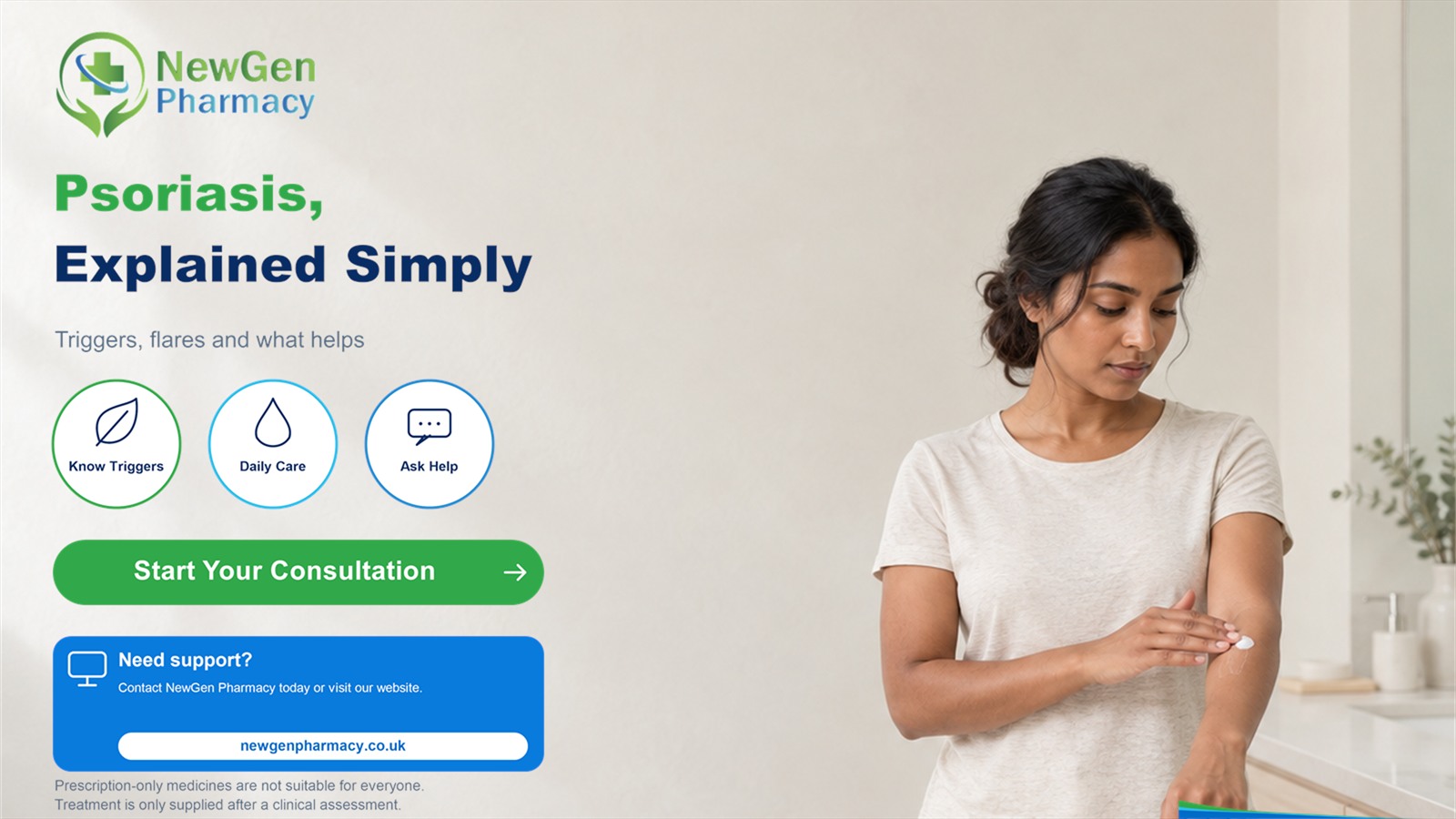
Psoriasis isn’t contagious, isn’t caused by poor hygiene, and isn’t just dry skin that needs more
moisturiser. It’s a condition where the immune system speeds up skin cell turnover, and that one
fact explains almost everything else about how it looks and how it’s treated.
This article covers what’s actually happening in the condition, the different ways it shows up,
the things that reliably trigger a flare, and the joint symptom that’s easy to miss but worth
mentioning to a GP.
In this article
- What psoriasis actually is
- Why it’s an immune condition, not a skin-surface problem
- Why skin cells turn over too fast
- What a plaque looks like
- Plaque psoriasis — the common one
- Scalp psoriasis and why it’s mistaken for dandruff
- Nail psoriasis — pitting and lifting
- Guttate psoriasis and the strep throat link
- Psoriasis or eczema? The practical differences
- Where each tends to appear on the body
- Itch versus soreness
- Common triggers: stress
- Common triggers: infection, injury, weather
- Medicines that can trigger a flare
- Alcohol, smoking and what the evidence says
- Emollients — the unglamorous foundation
- Why topical treatments need weeks, not days
- Scalp treatment is its own problem
- Psoriatic arthritis — the joint symptoms to report
- When to seek urgent help
- Living with a condition that comes and goes
What psoriasis actually is
Psoriasis is a long-term condition where the immune system mistakenly drives skin cells to turn
over far faster than normal — in days rather than weeks. That build-up of cells is what forms the
raised, scaly patches most people recognise. The
NHS guidance on
psoriasis covers the condition in more depth.
Why it’s an immune condition, not a skin-surface problem
Because the root cause is immune activity rather than the skin itself, it tends to come and
go in flares, and can be linked to other things going on in the body — which is part of why it’s
treated differently from simple dry or irritated skin.
Why skin cells turn over too fast
Normal skin replaces itself over roughly a month. With this condition, that cycle can shrink to
three or four days, which doesn’t give old skin cells time to shed normally — they pile up
instead, forming the characteristic plaques.
What a plaque looks like
Plaques are typically raised, red or pink patches (though colour can look different on darker
skin) with a silvery-white scale on top. They’re often symmetrical — appearing on both elbows, or
both knees, rather than just one side.
Plaque psoriasis — the common one
This is the most common form by far, typically affecting elbows, knees, the lower back
and the scalp. It can range from a couple of small patches to widespread involvement.
Scalp psoriasis and why it’s mistaken for dandruff
This variant can look similar to severe dandruff at a glance, but it tends to be more clearly
raised, more defined at the edges, and can extend slightly beyond the hairline onto the forehead
or around the ears in a way dandruff doesn’t.
Nail psoriasis — pitting and lifting
The condition can affect the nails too, causing small pits, discolouration, thickening, or the
nail lifting away from the nail bed. It’s often overlooked as “just” a nail problem when it’s
actually part of the same picture.
Guttate psoriasis and the strep throat link
This form shows up as small, drop-shaped spots scattered over the trunk and limbs, and is
notable for often appearing suddenly after a streptococcal throat infection, particularly in
children and young adults. It can resolve on its own or develop into a more ongoing pattern.
Psoriasis or eczema? The practical differences
Eczema tends to be itchier
than psoriasis, which is often described as sore or tight rather than intensely itchy. Eczema
patches are usually less sharply defined at the edges than its plaques, and the two also
tend to favour different areas of the body.
Where each tends to appear on the body
It favours the elbows, knees, lower back and scalp. Eczema more often affects the creases —
behind the knees, inside the elbows — though both conditions can appear almost anywhere, so
location alone isn’t a reliable rule.
Itch versus soreness
Itch dominates in eczema. It can itch too, but soreness, tightness and a burning sensation
around plaques are just as common, which is one of the more useful clues when the two are hard to
tell apart by sight.
Common triggers: stress
Stress is one of the most consistently reported triggers for it. It doesn’t cause the
underlying condition, but it can bring on a flare or make an existing one worse.
Common triggers: infection, injury, weather
Infections — throat infections especially — can trigger flares, as can injury to the skin
including cuts, scrapes and even sunburn (a pattern sometimes called the Koebner response). Cold,
dry weather tends to make it worse for many people, while some find sunlight helps.
Medicines that can trigger a flare
Certain medicines are known to trigger or worsen it in some people, including some blood
pressure treatments, lithium, and antimalarial drugs. If you notice a flare after starting a new
medicine, it’s worth mentioning to whoever prescribed it rather than assuming it’s unrelated.
Alcohol, smoking and what the evidence says
Both smoking and heavier alcohol use are associated with more severe psoriasis and can make
treatment less effective. Neither causes it outright, but both are worth knowing about if
you’re trying to get flares under better control.
Emollients — the unglamorous foundation
Regular emollient use — plain, unfragranced moisturiser applied generously and often — is the
unglamorous foundation most treatment for it sits on top of, as the
British Association of
Dermatologists sets out in its patient guidance. It won’t clear plaques on its own, but it
reduces scaling and discomfort and supports whatever active treatment is being used.
Why topical treatments need weeks, not days
Topical treatments for it typically need several weeks of consistent use before you can fairly
judge whether they’re working. Stopping after a few days because nothing’s changed is one of the
most common reasons treatment appears to fail when it might just need more time.
Scalp treatment is its own problem
Hair makes applying treatment to the scalp genuinely harder, and scalp-specific formulations —
gels, foams, shampoos — exist partly to solve that practical problem rather than because the
scalp needs a fundamentally different medicine.
Psoriatic arthritis — the joint symptoms to report
Up to 30% of people with psoriasis go on to develop
psoriatic
arthritis, which affects the joints and is frequently missed because people don’t connect
joint pain to a skin condition. Signs include joint pain, stiffness — particularly in the morning
— swelling, and sometimes swelling of an entire finger or toe.
If you have it and notice new joint symptoms, mention it to a GP. Catching psoriatic
arthritis early makes a real difference to long-term joint health.
When to seek urgent help
Most of the time it’s uncomfortable rather than dangerous, but two rare forms are medical emergencies:
erythrodermic psoriasis (widespread redness covering most of the body) and generalised pustular
psoriasis (widespread pus-filled blisters, often with fever and feeling generally unwell). Both
need same-day medical assessment — call 999 or go to A&E if you or someone you’re with develops
either alongside feeling seriously unwell. The
NICE guideline on
psoriasis assessment and management sets out when specialist referral is needed.
Living with a condition that comes and goes
Psoriasis is a long-term condition, and most people go through cycles of flares and calmer
periods rather than a single continuous experience. Specialist treatments exist beyond what any
online service can supply — for widespread or severe disease, dermatology referral opens up
options that go further than topical treatment alone.
If dry, flaky or scaly skin is part of a wider picture rather than a clear pattern like this, our
fungal skin
infections page covers a different, equally common cause worth ruling out.
🔴 NewGen’s psoriasis service is for mild to moderate psoriasis in adults that’s been **previously
diagnosed** and affects limited areas — if this is the first time you’ve noticed a patch like
this, see a GP for diagnosis first rather than starting a consultation here. If you already have a
diagnosis and want treatment for a flare,
start your consultation and a UK
prescriber will take it from there. You can also read
how an online consultation works first,
or browse the full treatment list if
something else is going on alongside it.
Frequently Asked Questions
Is psoriasis contagious?
No. It’s an immune condition, not an infection, and cannot be passed to anyone else.
Is it caused by poor hygiene?
No. It has nothing to do with hygiene — it’s driven by the immune system, not by anything
external on the skin.
Psoriasis or eczema — how do I tell?
Its plaques tend to be more sharply defined with a silvery scale and favour elbows, knees
and the scalp. Eczema is usually itchier, less defined at the edges, and favours skin creases. An
online skin diagnosis can
help if you’re not sure.
Will it ever go away?
It’s a long-term condition that tends to come and go in flares rather than resolving
completely, though good treatment can keep it well controlled for long stretches.
Why does my scalp flake?
The scalp form can look like severe dandruff but tends to be more clearly raised and defined at
the edges, sometimes extending slightly onto the forehead or around the ears.
Does stress cause it?
Stress doesn’t cause it, but it’s one of the most commonly reported triggers for a flare
once someone has the condition.
Can sunlight help?
Many people find moderate sun exposure helps it, though sunburn can trigger flares
via skin injury — so it’s a balance, not a blanket rule.
How long do treatments take to work?
Most topical treatments need several weeks of consistent use before you can fairly judge whether
they’re helping. Stopping too early is a common reason treatment seems not to work.
Can it affect my nails?
Yes. It can cause pitting, discolouration, thickening or the nail lifting away from
the bed, and is sometimes overlooked as a separate problem.
Should I worry about joint pain?
Yes, it’s worth mentioning to a GP. Up to 30% of people with it develop psoriatic
arthritis, and catching it early makes a real difference.
Can medicines trigger it?
Some can, including certain blood pressure medicines, lithium and antimalarials. Mention any new
flare after starting a medicine to whoever prescribed it.
Is it linked to other health conditions?
It’s associated with a higher risk of certain other conditions, including psoriatic
arthritis and cardiovascular risk factors, which is part of why ongoing care matters even when
skin symptoms are mild.
Compliance note
This article is general health information about this condition, based on NHS, NICE and British
Association of Dermatologists guidance and on the services listed on the NewGen Pharmacy website
at the time of writing. Guidance, service availability and eligibility may change. It is not a
diagnosis, a treatment recommendation, or a promise that any treatment will be supplied. Treatment
depends on clinician assessment, patient suitability, and whether it is safe, lawful and
clinically appropriate, and the final prescribing decision always rests with the clinician.
Erythrodermic and generalised pustular psoriasis are medical emergencies — call 999 or go to A&E
for widespread redness or pus-filled blisters with fever or feeling seriously unwell. Specialist
treatment for severe or widespread disease goes beyond what any online service supplies. For
symptoms that are severe, unusual or worsening but not an emergency, contact a GP or NHS 111.
Suspected side effects from any medicine can be reported to the MHRA through the
Yellow Card scheme.
Author & Content Writer: Dr. Naeem Aslam