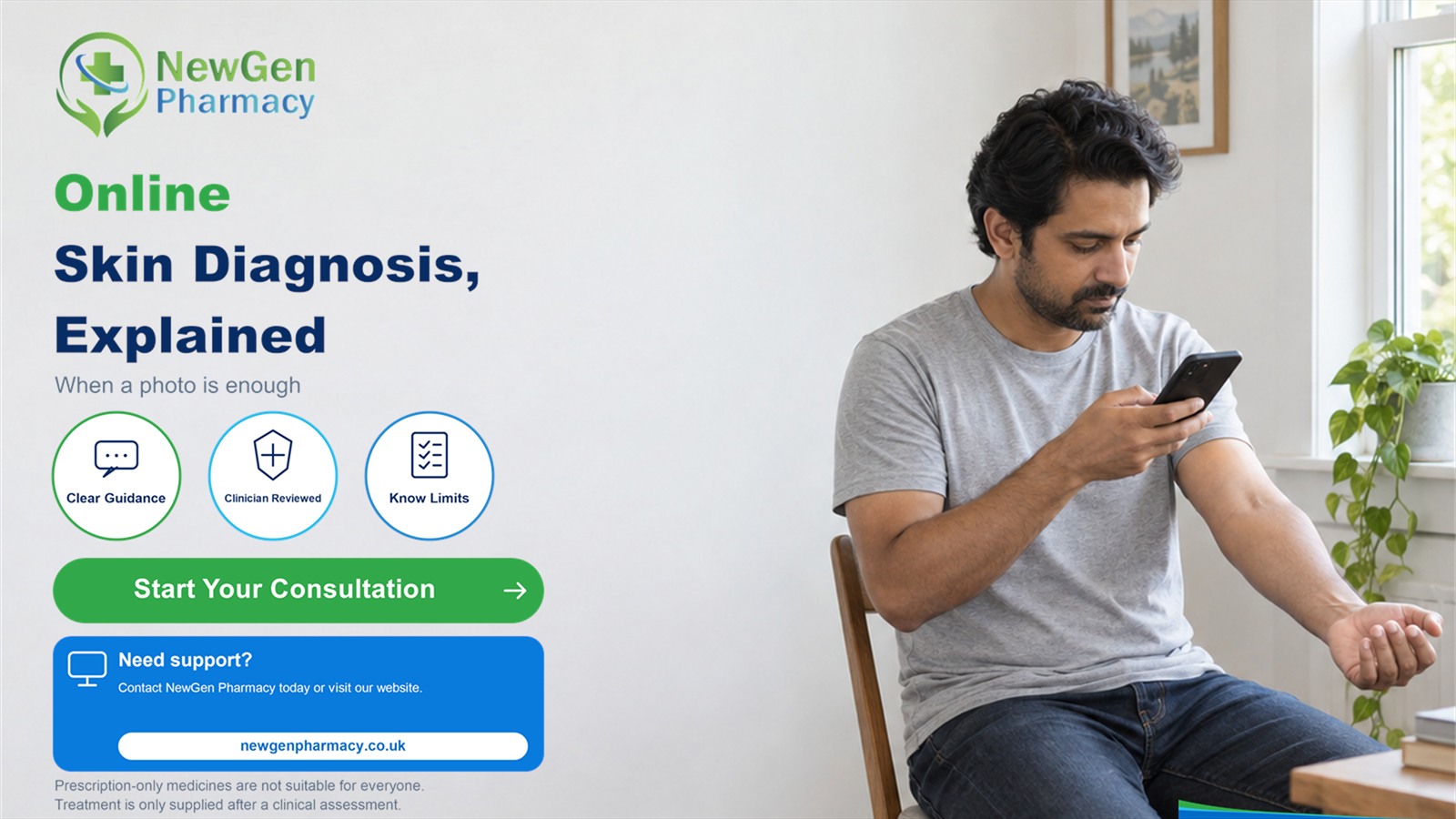
A photograph can tell a prescriber a great deal about your skin. It cannot tell them everything, and knowing where that line falls is the difference between a service that helps you and one that delays you.
NewGen Pharmacy’s online skin diagnosis is a photo-based clinical assessment. You describe what is happening, you upload a clear image, and a UK-registered prescriber sends back a written assessment of what it is likely to be and what should happen next.
Most importantly, “what should happen next” is not always a prescription. Sometimes it is a referral, and for a small number of presentations it is a referral that needs to happen quickly.
This article explains what online skin diagnosis can assess, what it deliberately will not assess, how to take a photograph a prescriber can use, and the skin changes that should take you to a GP instead of to any online form.
Patients can read the full service page for online skin diagnosis, browse the wider treatment list, see how a consultation works, or use the contact page with a question first.
In this article
- What the service actually is
- Who reviews the photograph
- What a photo assessment can reasonably cover
- What the service will not assess, and why
- Skin changes that should not go to any online form
- When skin symptoms are an emergency
- How to take a photograph a prescriber can use
- Why the questionnaire matters as much as the image
- Skin conditions take longer to treat than people expect
- Where this fits with the rest of the service
What the service actually is
Online skin diagnosis sits a step before treatment. Most consultations start with a patient who already knows what they have; this one starts with a patient who does not.
You complete a short questionnaire describing the affected area, how long the symptoms have been there, what you have already tried, and the relevant parts of your medical history. You then upload a clear photograph of the area. That combination of image and history is what makes online skin diagnosis workable at a distance.
A UK-registered prescriber reviews the submission and returns a written assessment. That assessment explains the likely condition, whether prescription treatment is needed, and whether NewGen can provide it or whether you should be seen elsewhere. Online skin diagnosis is designed to answer that question safely, not to guess at it.
Full details of how the assessment works, including what happens if you go on to a treatment consultation, are set out on the service page.
Who reviews the photograph
Every online skin diagnosis submission is reviewed by a prescriber. NewGen states plainly that the review is never an algorithm.
The clinical team is named publicly on the website. Dr Naeem Aslam is a medical doctor registered with the General Medical Council under GMC number 6121335. Nadia Zolfaghary is the Superintendent Pharmacist, registered with the General Pharmaceutical Council under GPhC number 2081303.
Both registration numbers are published so you can check them on the public registers instead of taking the claim on trust.
NewGen’s published turnaround for online skin diagnosis is a review usually within one working day, Monday to Friday, with submissions arriving after 3pm on a Friday generally reviewed on the next working day.
What a photo assessment can reasonably cover
Online skin diagnosis works best for conditions with a recognisable appearance, a recognisable pattern of spread, and a history that fits.
NewGen lists acne, eczema, rosacea, psoriasis, cold sores, herpes outbreaks, fungal skin and nail infections, and contact dermatitis among the conditions the service addresses.
These share a useful property: the photograph and the story together usually give a prescriber enough. Where a rash is, how it is distributed, how long it has been there, what makes it worse and what you have already used are often more diagnostic than the image alone.
The questionnaire is not a formality attached to the photo. It is half the assessment, and a thorough answer changes the quality of what online skin diagnosis can tell you.
What the service will not assess, and why
The exclusions are the most important part of this page, so they are set out in full. They exist because online skin diagnosis is a photo-triage service, not a substitute for examination.
The service excludes suspected skin cancer, lesions that would require a biopsy, and moles that are changing or bleeding. It excludes widespread or severely inflamed skin, and anyone who has a fever alongside the skin problem. It is for adults only and is not available to anyone under 18.
Each exclusion exists for a reason. A biopsy cannot be taken from a photograph. Skin cancer is diagnosed by examination and, where needed, by removing tissue and looking at it under a microscope, not by image review however good the image.
Widespread or severely inflamed skin can signal something affecting the whole body and needs someone to assess the whole patient, not one region. A fever alongside a rash changes the question entirely, because some causes of that combination are urgent.
If a patient cannot be assessed safely from a photograph, the correct outcome is referral guidance and not a prescription. That is the outcome online skin diagnosis is designed to produce when the limits are reached.
Skin changes that should not go to any online form
Some things need a GP appointment now and should not wait on online skin diagnosis or any online assessment.
The ABCDE guide is the standard way to check a mole:
- A — Asymmetry. The two halves do not match.
- B — Border. The edge is irregular, blurred, notched or ragged.
- C — Colour. Uneven, with different shades of brown, black, pink, red or blue.
- D — Diameter. Larger than about 6mm across, roughly the width of a pencil end.
- E — Evolving. Any change over weeks or months, in size, shape, colour, or sensation.
Of the five, change is the most useful single sign. A new mole, or an existing one that is growing, changing colour, changing shape, itching, crusting or bleeding, should be shown to a GP. The NHS sets out what to look for in a suspicious mole. Melanoma is treated far more successfully when it is found early, and there is nothing lost by having something harmless looked at.
A warning about the guide itself, which matters more than the guide. Not every melanoma follows ABCDE, as the British Association of Dermatologists patient leaflets explain. Nodular melanoma often appears as a raised, firm, symmetrical lump that grows quickly, and amelanotic melanoma can be pink, red or skin-coloured with no dark pigment at all. Both can pass every letter and both are among the more aggressive types. Anything new, growing, firm, bleeding or simply not healing deserves review even if it looks nothing like the pictures.
GPs use a weighted seven-point checklist for pigmented lesions, and NICE guidance on suspected cancer referral is that a score of three or more warrants referral on a suspected cancer pathway, for an appointment within two weeks. That assessment needs a clinician looking at your skin, which is exactly what online skin diagnosis is not designed to replace.
When skin symptoms are an emergency
A small number of skin presentations need immediate help, not an appointment, and not online skin diagnosis.
Call 999 for swelling of the face, lips, mouth or throat, difficulty breathing or swallowing, or a widespread rash with faintness or collapse. These can indicate a severe allergic reaction.
Call 999 or go to an emergency department for a rash with fever that does not fade when a glass is pressed against it. Do not wait for a rash to appear or to become non-blanching before seeking help if someone is very unwell, because this is a late sign and not an early one — the NHS guidance on spotting sepsis covers the earlier warning signs.
Seek urgent same-day assessment for redness that is spreading quickly, skin that is hot, painful and swelling, blistering over a large area, or any skin problem alongside feeling very unwell.
Skin that is peeling in sheets, or a rash involving the eyes, mouth or genitals with fever, also needs urgent assessment.
How to take a photograph a prescriber can use
Most online skin diagnosis submissions that cannot be assessed fail on the image and not on the condition. A few minutes on the photograph is the best thing you can do for your own turnaround time.
Use natural daylight where you can. Indoor lighting shifts colour, and colour is diagnostic. A rash that looks purple under a warm bulb may be red in daylight.
Take more than one image. A close-up shows texture and detail; a wider shot shows distribution, which is often what identifies the condition. Both together are far more useful than either alone.
Hold the camera steady and check the image is in focus before uploading. Skin detail disappears completely in a slightly blurred photo.
Include something for scale if size matters, such as a fingertip or a coin beside the area. Avoid filters, beauty modes and heavy editing, all of which remove exactly the information the prescriber needs.
Photograph the area as it is now, not at its worst last week. If it looked dramatically different a few days ago, say so in the questionnaire instead of submitting the older picture. Online skin diagnosis relies on the picture matching the story you tell.
Why the questionnaire matters as much as the image
Two people can submit visually similar rashes to online skin diagnosis and need completely different answers, because the history differs.
Duration matters. Something present for three days and something present for three years are rarely the same problem, even when they look alike.
What you have already tried matters, including things that did not work. A condition that has not responded to an appropriate first-line treatment is a different clinical situation from one never treated.
Other medicines matter, because some skin reactions are caused by medication and not by skin disease. Anything started in the weeks before a rash appeared is particularly worth mentioning.
Whether anyone around you has the same thing, whether it itches or hurts, and whether anything reliably triggers it all narrow the answer considerably, and this is what makes online skin diagnosis useful rather than a guess from a single image.
Skin conditions take longer to treat than people expect
A realistic timeline prevents most of the disappointment around skin treatment, whether it started with online skin diagnosis or a direct treatment consultation.
Acne treatments generally need several weeks before a fair judgement can be made, and skin can look worse before it looks better. Stopping at two weeks is the most common reason a treatment appears not to work.
Eczema is managed and not cured, and regular emollient use is the foundation the rest sits on, not an optional extra alongside it.
Psoriasis is a long-term condition that comes and goes. It is not contagious and it is not caused by poor hygiene, both of which are worth saying because both myths persist.
Fungal nail infections are slowest of all. A nail grows out over many months, so visible improvement is measured in months, and confirming the diagnosis before starting a long course is worth the delay.
The most useful thing an assessment gives you is often not the treatment itself but a realistic expectation of how long it should take and when to come back if it has not worked.
Where this fits with the rest of the service
If you already know what you have, you do not need this step, and online skin diagnosis is not required. NewGen lists individual consultation routes for each of the conditions named above, each with its own assessment.
Online skin diagnosis is for the situation before that, when you have something on your skin and no confident name for it.
Treating the wrong condition for a month sets you back a month, which is the argument for settling the question with online skin diagnosis first.
If you are not sure what you are looking at, you can start your consultation and a prescriber will tell you.
Frequently Asked Questions
What is online skin diagnosis?
A photo-based clinical assessment. You describe your symptoms and upload a clear image, and a UK-registered prescriber returns a written assessment of the likely condition and what should happen next.
What do I get back?
A written assessment explaining the likely condition, whether prescription treatment is needed, and whether NewGen can help or you should be seen elsewhere. Service details are set out on the online skin diagnosis service page.
Who reviews my photograph?
A UK-registered clinician, never an algorithm. Dr Naeem Aslam (GMC 6121335) and Nadia Zolfaghary, Superintendent Pharmacist (GPhC 2081303), are named on the website with checkable registration numbers.
How long does it take?
NewGen publishes a turnaround for online skin diagnosis of usually within one working day, Monday to Friday. Submissions after 3pm on a Friday are generally reviewed the next working day.
Which conditions can it assess?
NewGen lists acne, eczema, rosacea, psoriasis, cold sores, herpes outbreaks, fungal skin and nail infections, and contact dermatitis, among others.
Can it check a mole or possible skin cancer?
No. Suspected skin cancer, lesions needing a biopsy, and changing or bleeding moles are excluded. These need in-person assessment by a GP, who can refer on a suspected cancer pathway where appropriate.
My mole does not match the ABCDE signs. Does that mean it is fine?
Not necessarily. Nodular and amelanotic melanomas can be symmetrical, evenly coloured, small or without dark pigment, and still be serious. Anything new, growing, firm, bleeding or not healing should be seen, whatever it looks like.
What else is excluded?
Widespread or severely inflamed skin, skin problems with a fever, and anyone under 18. If you cannot be safely assessed from a photograph, online skin diagnosis will give you referral guidance instead.
What makes a good photograph?
Natural daylight, sharp focus, one close-up and one wider shot showing distribution, something for scale if size matters, and no filters or editing. Photograph the area as it looks now, since online skin diagnosis depends on an accurate current picture.
When should I skip this and get help immediately?
Call 999 for swelling of the face, lips or throat, difficulty breathing, or a rash with fever that does not fade under pressure from a glass. Seek same-day help for rapidly spreading redness or skin that is hot, painful and swelling.
Compliance note
This article describes the online skin diagnosis service, turnaround and exclusions published on the NewGen Pharmacy website at the time of writing, together with general skin health information based on NHS, NICE and British Association of Dermatologists guidance. Service details, availability and eligibility may change, and the service page is the authoritative source for current terms.
It is not a diagnosis and not a substitute for clinical assessment. A photo-based assessment has limits, and some skin conditions can only be diagnosed in person or by biopsy. Treatment is not automatic; it depends on clinician assessment, patient suitability, availability, and whether the option is safe, lawful and clinically appropriate, and the final prescribing decision always rests with the clinician.
Any new, changing, bleeding or non-healing skin lesion should be assessed by a GP, whether or not it matches the ABCDE signs. Call 999 for swelling of the face, lips or throat, difficulty breathing, or a rash with fever that does not fade under pressure. For symptoms that are severe, unusual or worsening, contact a GP, NHS 111 or urgent care. Suspected side effects from any medicine can be reported to the MHRA through the Yellow Card scheme.
Author & Content Writer: Dr. Naeem Aslam